
How eBay Scraping, Product Matching, and Digital Shelf Analytics Are Powering High-Performance Retail Brands in 2025
- Nov 24, 2025
- 3 min read
Retail and eCommerce competition in 2025 is more intense than ever. Prices change multiple times a day, product listings update hourly, and marketplaces launch new offers without notice. To stay ahead, brands now depend on real-time competitive data, product match accuracy, and digital shelf visibility across every retail channel.
This shift has made eBay scraping, product matching, eCommerce product data scraping, digital shelf analytics, and retail pricing intelligence essential for retail growth.
This blog explains how modern retail teams are using these advanced data capabilities to win more customers, increase conversions, and boost revenue in 2025.
Why Retailers Need Real-Time Marketplace Intelligence
Retailers face challenges like:
Price changes across thousands of SKUs
Competitor promotions running in short windows
Regional out-of-stock conditions
Marketplace ranking fluctuations
Disconnected product content
Duplicate or mismatched listings
Variations across mobile apps vs. websites
To solve these challenges, brands are shifting from manual research to automated data-driven retail intelligence systems.
1. eBay Scraping: Monitoring One of the World’s Fastest-Moving Marketplaces
eBay remains one of the most active marketplaces for price fluctuations, seller competition, and product availability changes. Brands use eBay Scraping to extract:
Live product prices
Condition-based variations (new/refurbished/used)
Seller competition
Bidding insights
Stock levels
Shipping and delivery timelines
Category trends
Why eBay Data Matters in 2025
Helps discover high-demand SKUs
Tracks price volatility
Identifies emerging sellers
Improves competitive benchmarking
Supports marketplace expansion strategy
eBay data is extremely valuable for retail brands planning global expansion, pricing updates, or competitive intelligence.
2. Product Matching: Ensuring Accuracy Across All Marketplaces
Retailers deal with thousands of SKUs, duplicate listings, and inconsistent product naming conventions across Amazon, eBay, Walmart, Shopify, Flipkart, and niche stores. To solve this, brands use Product Matching to identify similar, identical, or substitute products across different channels.
How Product Matching Helps Retailers
Eliminates catalog duplication
Maintains pricing accuracy
Aligns cross-channel product visibility
Helps detect counterfeit or fake listings
Improves competitive price comparison
Enhances product recommendation systems
Product matching is the backbone of accurate pricing, analytics, and assortment management.
3. Digital Shelf Analytics: Understanding How Your Brand Performs Online
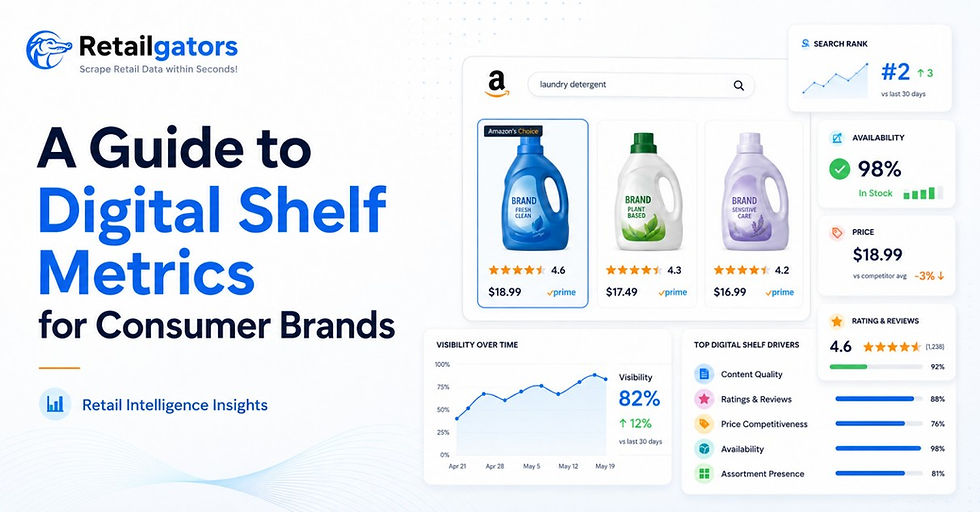
Retailers are now building advanced digital shelf systems to track their product performance across marketplaces. Digital Shelf Analytics helps brands monitor:
Buy Box visibility
Search ranking
Pricing consistency
Product content quality
Reviews & ratings
Stock status
Promotion performance
Why Digital Shelf Analytics Is a “Must-Have” in 2025
Influences marketplace conversions
Improves brand compliance
Detects listing issues instantly
Helps optimize organic ranking
Supports revenue optimization
Your digital shelf presence is now as important as your physical store display.
4. eCommerce Product Data Scraping: Full Visibility of Competitor Catalogs
Every retail team needs complete competitor intelligence to understand what products are trending, how often prices change, and how sellers position their listings. With eCommerce Product Data Scraping, brands extract:
Product titles, descriptions, attributes
Images, variants, colors, sizes
Category and sub-category data
Seller information
Price history
Promotions and discount changes
Stock availability
How Retailers Use This Data
Launch products based on market demand
Improve listing content quality
Track category-level opportunities
Build competitor benchmarking dashboards
This data becomes the foundation of a strong retail analytics strategy.
5. Retail Pricing Intelligence: Winning the Price War Without Losing Margin
Price is the #1 factor influencing online sales. Retailers now depend on Retail Pricing Intelligence to track:
Real-time competitor pricing
Price gaps
Demand-based pricing
Regional variations
Promotions & deal timing
MAP violations
Margin opportunities
Pricing Intelligence Helps Brands:
Automate repricing
Identify profitable price points
Prevent revenue leakage
Improve Buy Box win rate
Boost marketplace sales
With AI and data-driven pricing, retailers can respond faster and smarter than competitors.
How These Capabilities Combine Into a Powerful Retail Engine
When retailers integrate eBay scraping, product matching, product data scraping, digital shelf analytics, and pricing intelligence, they unlock:
✔ Complete market visibility✔ AI-powered demand forecasting✔ Accurate product comparisons✔ Price optimization for higher margins✔ Faster decision-making✔ Higher conversion rates✔ More competitive product positioning
This unified retail intelligence system is becoming essential for eCommerce brands in 2025.
Conclusion
Retail analytics in 2025 is driven by real-time data, automation, and smart intelligence systems. Retailers who invest in marketplace scraping, product accuracy, shelf visibility, and competitive pricing will outperform every competitor.
If your brand wants stronger market positioning, higher conversions, and better pricing control, now is the time to adopt these data-driven retail solutions.

Comments