
The Rise of Marketplace Intelligence: Etsy, AliExpress & Amazon Data Scraping Trends Every Retailer Should Know in 2025
- Nov 25, 2025
- 4 min read

The retail world in 2025 runs on one thing: marketplace intelligence. Every buying journey starts on platforms like Amazon, Etsy, AliExpress, Walmart, eBay, and niche vertical marketplaces. What shoppers see on these platforms—prices, reviews, product rankings, delivery timelines—directly influences which brand wins the sale.
This shift has pushed retailers, eCommerce brands, and even manufacturers to depend heavily on real-time marketplace data scraping to understand what customers want, how competitors behave, and where the market is moving.
In this blog, we break down the most important data scraping trends across Etsy, AliExpress, and Amazon, and explain why marketplace intelligence is the most valuable retail asset of 2025.
Why Marketplace Intelligence Is Exploding in 2025
Retailers can no longer rely on outdated reporting or guesswork. Marketplaces now update:
Prices every few minutes
Stock levels multiple times an hour
Search rankings based on live performance
Reviews and ratings in real time
Promotions and coupons every day
This means brands must monitor marketplaces continuously to stay competitive. That’s why tools like price monitoring services and marketplace scraping APIs have become essential.
1. Etsy Data Scraping: Tracking Handmade, Vintage & Niche Retail Trends
Etsy has become the world’s top platform for unique, hand-crafted, personalized, and niche products. Because the market moves fast, retailers now use etsy data scraping to analyze:
✔ Trending handmade products
What is going viral? What is selling fast? What new categories are emerging?
✔ Seller pricing strategies
Etsy sellers often change prices based on demand, season, and customer interest.
✔ Style, color & design trends
Perfect for businesses in fashion, accessories, jewelry, home décor, art, and custom printing.
✔ Product listing optimization
Successful Etsy listings can be reverse-engineered using data.
Why Etsy Intelligence Matters
Large brands now use marketplace scraping to detect micro-trends early before they scale into mainstream demand.
2. AliExpress Scraping: Understanding Global Dropshipping & Low-Cost Market Trends
AliExpress still dominates the dropshipping and low-cost product ecosystem. Retail brands use aliexpress scraping to extract high-volume, real-time intelligence such as:
✔ Supplier pricing changes
AliExpress sellers adjust prices multiple times a day.
✔ Wholesale discounts & MOQ shifts
Important for bulk buyers, resellers, and retailers.
✔ Shipping times, logistics trends
Dropshippers depend heavily on this data.
✔ New product launches & niche categories
AliExpress is often the first place new low-cost products appear.
How Retailers Use AliExpress Data
Compare supplier pricing
Analyze top-selling items
Detect global demand patterns
Validate product ideas before launching
AliExpress scraping gives retailers a window into global consumer behavior.
3. Amazon Data Scraper: The Most Powerful Source of Marketplace Intelligence
Amazon is the largest marketplace in the world—and the most competitive. Using an amazon data scraper, retailers track all the crucial elements:
✔ Buy Box winners
Who wins? Why? At what price?
✔ Listing quality scores
Title, bullets, images, A+ content, and SEO keywords.
✔ Product rankings
How products move up or down in search results.
✔ Review patterns & sentiment
Critical for improving product quality.
✔ Stock levels & fulfillment types
FBA vs. FBM can dramatically affect sales.
✔ Price fluctuations
Amazon updates prices faster than any other marketplace.
Why Amazon Data Is Essential for 2025 Retailers
Amazon is the benchmark for price, assortment, customer expectations, and delivery speed. Brands use Amazon data to build pricing strategy, launch new SKUs, optimize listings, and stay ahead of competitors.
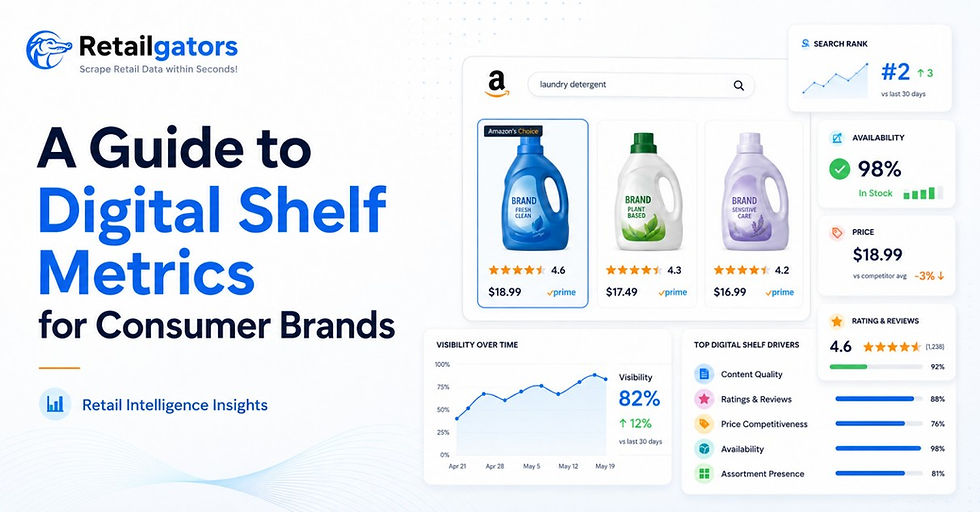
4. Digital Shelf Analytics: The New Brain of Retail Decision-Making
As marketplace complexity increases, retailers now use digital shelf analytics services to merge all their marketplace data into one intelligent dashboard.
Digital shelf analytics includes:
✔ Share of Search Tracking
Where your product ranks for important keywords.
✔ Price & promotion visibility
Which items are discounted? Which ones are price leaders?
✔ Content compliance
Are product images, titles, bullets, and descriptions compliant with brand rules?
✔ Availability & stockout tracking
Stockouts kill visibility and rankings—retailers track this daily.
✔ Rating & review intelligence
Identify negative patterns and fix product issues early.
Why It Matters
The digital shelf is the new “store shelf.” If your product isn’t visible, optimized, priced right, and stocked, you lose the sale instantly.
5. Price Monitoring: The Foundation of Marketplace Competitiveness
With marketplaces updating prices multiple times an hour, brands must track competitors continuously. That’s where advanced price monitoring services are used for:
Real-time competitor pricing
Price drop alerts
Seasonal pricing trends
MAP violation detection
Automated repricing workflows
Why Brands Use Price Monitoring
→ To stay competitive→ To protect margins→ To avoid losing customers to cheaper alternatives→ To predict market shifts
This gives businesses a major advantage in a market where shoppers compare prices instantly.
The Biggest Marketplace Intelligence Trends of 2025
1. AI-Powered Product Trend Detection
AI models now scan Etsy, AliExpress, and Amazon to detect early product demand.
2. Real-Time Repricing with Data Feeds
Dynamic pricing connected directly to marketplace data.
3. Deep Review & Sentiment Analytics
Understanding customer pain points instantly.
4. Unified Marketplace Dashboards
Digital shelf analytics combines data from all marketplaces.
5. Mobile Shopping Intelligence
Marketplace activity is increasingly driven by app data.
Conclusion: Marketplace Data Is the New Competitive Advantage
In 2025, the brands that win are those who understand marketplaces better than anyone else. By using data scraping from Etsy, AliExpress, and Amazon—combined with price monitoring and digital shelf analytics—retailers gain:
✔ Early visibility into trends✔ Competitive pricing power✔ Better product positioning✔ Higher conversions✔ Faster go-to-market✔ Stronger customer satisfaction
Marketplace intelligence isn’t optional anymore—it's a core business strategy.

Comments