
The Role of Big Data in Omnichannel Retail Strategies
- May 1
- 4 min read
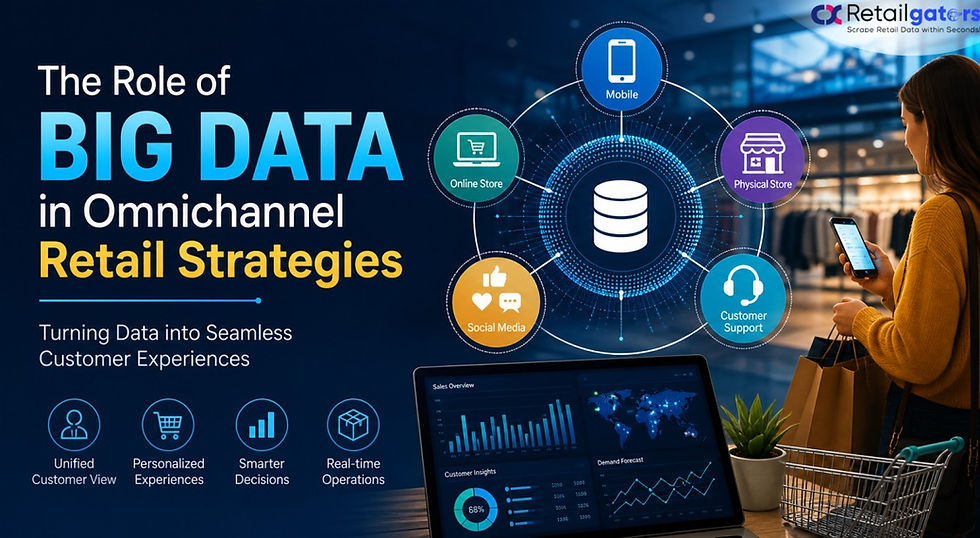
In today’s fast-moving retail landscape, customer expectations are higher than ever. Shoppers no longer interact with brands through just one channel—they browse products on mobile apps, compare prices on websites, visit physical stores, and engage through social media. This shift has made omnichannel retail not just a trend but a necessity.
At the center of this transformation lies big data. Retailers that know how to collect, analyze, and act on large volumes of data are the ones gaining a competitive edge. But how exactly does big data support omnichannel strategies? Let’s break it down in a practical, business-focused way.
Understanding Omnichannel Retail in Simple Terms
Omnichannel retail means creating a seamless shopping experience across all platforms—online, offline, and everything in between. Whether a customer starts browsing on their phone and completes the purchase in-store, or vice versa, the experience should feel consistent.
However, delivering this level of consistency is not easy. Each channel generates massive amounts of data, and without proper management, it becomes difficult to connect the dots. That’s where big data plays a crucial role.
What Is Big Data in Retail?
Big data refers to the large and complex datasets generated from multiple sources such as:
Online browsing behavior
Purchase history
Customer reviews and feedback
Social media interactions
In-store transactions
Inventory and supply chain data
When analyzed correctly, this data provides deep insights into customer behavior, preferences, and buying patterns.
Why Big Data Matters in Omnichannel Retail
Retailers are no longer competing just on price or product quality—they are competing on customer experience. Big data enables businesses to understand customers at a granular level and deliver personalized, consistent experiences across all touchpoints.
Here’s how it makes a difference.
1. Creating a Unified Customer View
One of the biggest challenges in omnichannel retail is fragmented customer data. A shopper might appear as different users across platforms—website, mobile app, and in-store purchases.
Big data helps unify this information into a single customer profile. This allows retailers to:
Track customer journeys across channels
Understand buying behavior more accurately
Deliver consistent messaging and offers
For example, if a customer browses a product online but doesn’t purchase, the retailer can trigger a personalized email or offer when they visit the store.
2. Personalization at Scale
Customers expect brands to understand their preferences. Generic marketing no longer works.
With big data, retailers can deliver hyper-personalized experiences, such as:
Product recommendations based on past behavior
Personalized discounts and offers
Customized email and ad campaigns
This level of personalization not only improves engagement but also increases conversion rates and customer loyalty.
3. Real-Time Inventory Visibility
Nothing frustrates a customer more than seeing a product online only to find it out of stock in-store.
Big data enables real-time inventory tracking across all channels. This helps retailers:
Maintain accurate stock levels
Enable “buy online, pick up in store” (BOPIS)
Reduce lost sales due to stockouts
It also improves operational efficiency by aligning supply with demand.
4. Smarter Pricing and Promotions
Pricing strategies have become more dynamic than ever. Retailers must adjust prices based on demand, competition, and customer behavior.
By analyzing large datasets, businesses can:
Monitor competitor pricing
Identify price-sensitive customer segments
Optimize discounts and promotional campaigns
This leads to better margins while still remaining competitive in the market.
5. Enhancing Customer Experience
Big data helps retailers understand what customers want—even before they explicitly say it.
By analyzing browsing patterns, feedback, and interactions, businesses can:
Improve website navigation
Optimize store layouts
Offer faster and more relevant customer support
A smoother experience across channels directly translates into higher satisfaction and repeat purchases.
6. Predictive Analytics for Better Decision-Making
One of the most powerful aspects of big data is predictive analytics.
Retailers can use historical data to forecast:
Future demand for products
Seasonal buying trends
Customer churn risks
This allows businesses to make proactive decisions rather than reactive ones. For instance, predicting demand helps avoid overstocking or understocking issues.
7. Optimizing Marketing ROI
Marketing budgets are often wasted on campaigns that don’t deliver results. Big data helps retailers track performance across channels and identify what’s working.
With data-driven insights, businesses can:
Allocate budgets more effectively
Target the right audience segments
Measure campaign performance in real time
This ensures every marketing dollar is used efficiently.
Challenges Retailers Face with Big Data
While the benefits are clear, implementing big data strategies is not without challenges:
Managing large volumes of data from multiple sources
Ensuring data accuracy and consistency
Integrating legacy systems with modern platforms
Maintaining data privacy and compliance
Retailers need the right tools, infrastructure, and expertise to overcome these challenges.
The Future of Big Data in Omnichannel Retail
As technology continues to evolve, the role of big data will only become more significant. Emerging trends such as AI, machine learning, and real-time analytics are making data even more powerful.
In the coming years, retailers will move towards:
Fully automated personalization
Advanced demand forecasting
Seamless integration of online and offline experiences
Those who invest in data-driven strategies today will be better positioned to lead the market tomorrow.
Final Thoughts
Big data is no longer optional in omnichannel retail—it’s a core business driver. From understanding customer behavior to optimizing operations and marketing, data empowers retailers to make smarter decisions and deliver better experiences.
In a world where customers interact with brands across multiple touchpoints, the ability to connect and analyze data is what separates successful retailers from the rest.
If your retail strategy isn’t powered by data yet, now is the time to start. Because in omnichannel retail, the real advantage doesn’t come from having data—it comes from knowing how to use it effectively.

Comments